Imagine waking up one morning and not being able to see the faces of your children. Not because of age, not because of fate, but simply because you were born in the wrong village, in the wrong district, without access to a single doctor within thirty kilometers.
This is not a hypothetical. This is the daily reality for millions of people living in the rural heartlands of Pakistan, places like Badomalhi, Narowal, and hundreds of unnamed villages scattered across Punjab and beyond.
But something extraordinary is quietly happening in these forgotten corners of the country. A team of dedicated volunteers, doctors, and supporters is showing up, sometimes in dusty minibuses, sometimes on unpaved roads, with one singular mission: to give people back their sight, completely free of charge.
This is the story of the Syed Faqir Ullah Shah Welfare Foundation’s Free Eye Camps and why they matter more than most people realize.
The Silent Crisis of Vision Loss in Pakistan
Before we talk about solutions, it’s worth understanding the scale of the problem.
Pakistan ranks among the countries with the highest rates of preventable blindness in the world. According to health experts, an estimated 1.5 to 2 million people in Pakistan are blind, and tragically, a significant majority of these cases are completely preventable or treatable with timely medical intervention.
Cataracts, glaucoma, diabetic retinopathy, and trachoma are conditions that, in urban hospitals, are routinely treated in outpatient procedures. But for a woman living in a remote district of Punjab or Sindh, a cataract that slowly steals her vision over months may go untreated for years. Not because she doesn’t want treatment. But because she cannot afford it, cannot travel, and has no one to take her.
The gap between urban healthcare access and rural healthcare reality in Pakistan is not just wide; it is devastating. And vision loss, quiet and creeping as it is, often does not feel like an emergency until it is far too late.
This is exactly the gap that SFUSWF’s Free Eye Camps were designed to bridge.
What Happens at a Free Eye Camp?
If you’ve never attended a medical camp in a rural Pakistani setting, it’s hard to fully picture the scene. Let us walk you through it.
Days before the camp, the foundation’s team, volunteers from the Mini Faqiri, Team Sakina, and Vanguard wings, spreads word through local mosques, community leaders, and door-to-door outreach. There is no billboard advertising, no digital campaign. It is old-fashioned community trust, built over years of consistent service.
On the day of the camp, patients begin arriving before sunrise. Elderly women wrapped in bright dupattas. Elderly men leaning on walking sticks. Young mothers holding children who squint painfully in the morning light. Farmers who haven’t been able to read a seed packet in three years. They arrive from nearby villages, some having walked for hours.
The setup is methodical and efficient:
Patient Registration and History Taking
Every patient is registered, their basic health history is noted, and they are assigned to the appropriate screening queue. Volunteers, many of them young students giving their weekend to this cause, handle logistics, crowd management, and patient comfort.
Comprehensive Eye Screening
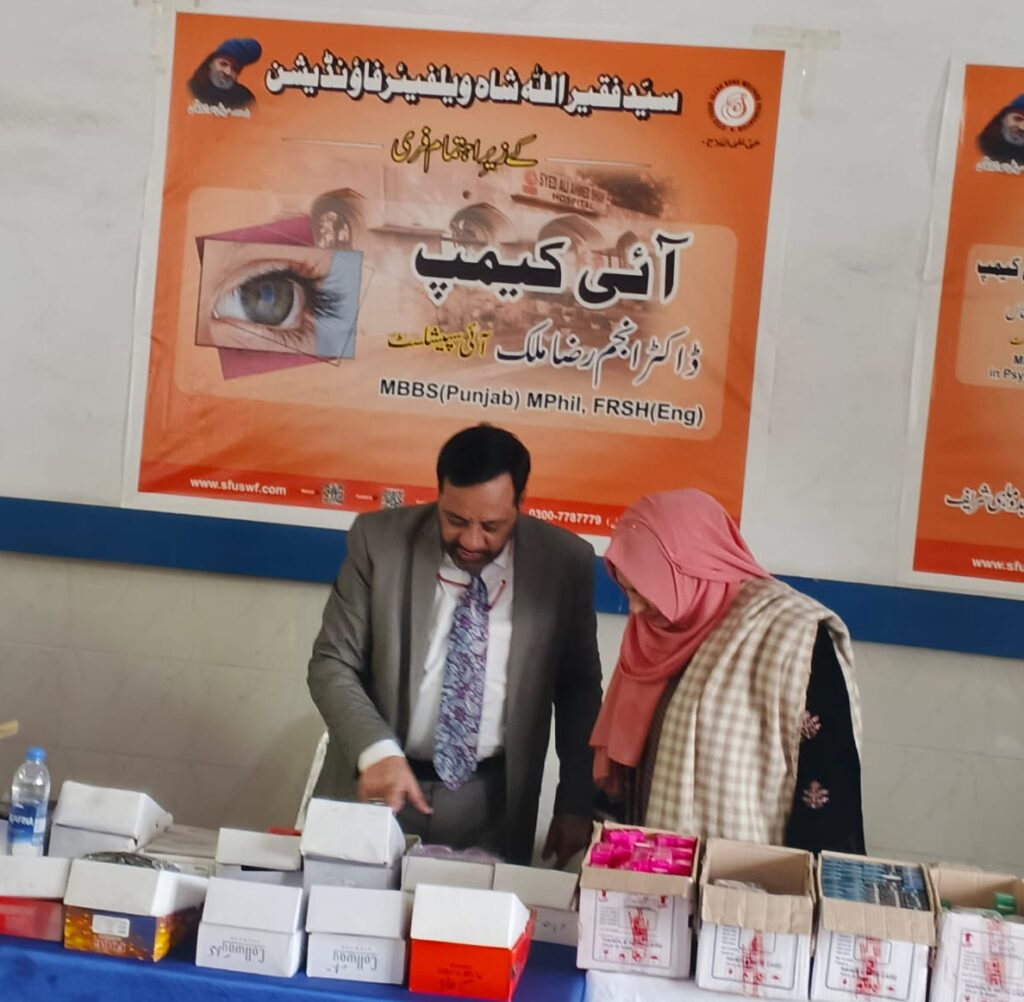
Qualified ophthalmologists conduct thorough eye examinations. Visual acuity tests, intraocular pressure checks for glaucoma, and retinal assessments are all performed with the same clinical precision you’d expect in a private hospital, only here, the patients pay nothing.
Diagnosis and Treatment
For patients with minor refractive errors, free prescription glasses are distributed on the spot. For more serious conditions like cataracts, patients are identified for surgical referral, either to a mobile surgical unit or to the Syed Ali Ahmad Shah Free Hospital at Dargah Alia Badomalhi Sharif.
Medicines and Follow-Up
Prescribed medicines, eye drops, and follow-up instructions are provided at no cost. Patients who need ongoing care are enrolled in the foundation’s follow-up tracking system to ensure continuity.
From start to finish, every service, consultation, diagnosis, medicine, and surgery referral is completely free. No hidden charges. No “registration fees.” Nothing
The Syed Ali Ahmad Shah Free Hospital: A Dream Becoming Reality
At the heart of SFUSWF’s vision healthcare mission sits a project that the foundation’s Founder and Chairman has dreamed of for decades: the Syed Ali Ahmad Shah Free Hospital, located at Dargah Alia Badomalhi Sharif in District Narowal.
This hospital is not just a building. It is a statement, a declaration that the poorest Pakistani, living in the most remote corner of this country, deserves the same quality of ophthalmic care as someone in Lahore or Karachi.
The hospital is equipped to handle:
- Cataract surgeries, the single most common cause of preventable blindness in Pakistan
- Corneal assessments and treatments
- Glaucoma management and monitoring
- Pediatric eye care, because children, too, suffer from undiagnosed vision impairment that hampers their learning and development
- Post-operative recovery and care
For many patients, reaching this hospital means traveling for the first time beyond their home district. For some elderly patients, it is genuinely the furthest they have ever been from home. And yet, when they leave, often a day or two later, their vision restored, the expressions on their faces are indescribable.
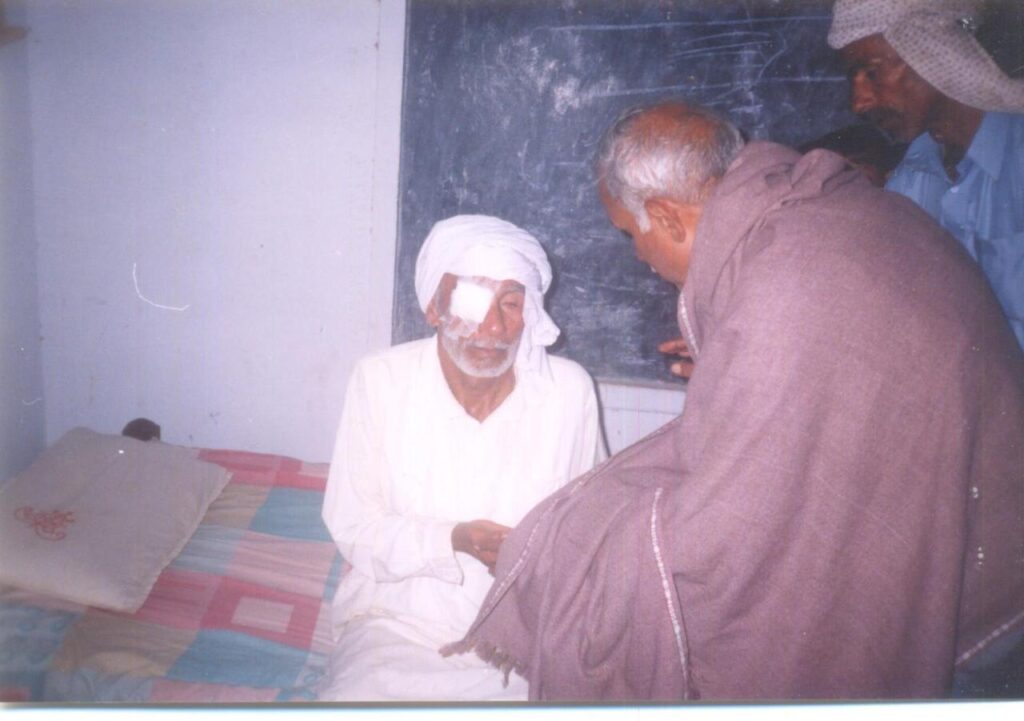
The foundation has documented cases of patients who had been completely blind in one or both eyes for years, sometimes decades, due to cataracts. After a procedure that takes less than thirty minutes, they can see again. They can see the faces of their grandchildren. They can see the color of the sky.
How do you put a price on that?
Stories from the Ground: Real Lives, Real Change
Numbers tell one kind of story. But the human stories are what truly capture what this work means.
The Grandmother Who Saw Her Granddaughter’s Face
One of the volunteers recalls an elderly woman from a village near Sialkot who arrived at a Free Eye Camp almost entirely blind in both eyes due to advanced cataracts. She had been living in near-total darkness for almost four years. Her family had assumed it was simply “old age” and that nothing could be done.
After her examination, she was referred for surgery at the Syed Ali Ahmad Shah Free Eye Hospital. Two days later, when the bandages were removed, she looked at her granddaughter, a little girl of about seven who had come along for the journey, and began to weep.
“I didn’t know she had grown so tall,” she said.
The Farmer Who Couldn’t Read His Land Papers
A farmer in his late fifties had been struggling with worsening vision for years. Unable to read the land documents he needed to navigate a property dispute, he had nearly lost his agricultural land, land that had been in his family for generations.
After receiving a free pair of prescription glasses at one of SFUSWF’s eye camps, he could read clearly for the first time in years. The legal matter was resolved. His land was saved.
Something as simple as a pair of glasses. Something the rest of us take completely for granted.
Why Free Eye Camps Are More Than a Medical Intervention
It would be easy to look at Free Eye Camps purely as a healthcare initiative. And they are a very important one. But the ripple effects of restoring someone’s vision go far deeper than the clinical.
Economic empowerment: A person who can see clearly can work. A farmer who regains vision can tend his fields. A woman who can see can continue her embroidery work. Vision is directly tied to livelihood, especially in communities where manual labor and trade are the economic backbone.
Education: Children with undiagnosed vision problems fall behind in school. They are often mislabeled as slow learners, or they drop out entirely. A child who receives glasses or treatment at a young age has their entire educational trajectory changed.
Mental health and dignity: The psychological toll of progressive blindness is enormous. The fear, the dependence on others, and the loss of autonomy, these are real and devastating. Restoring vision restores dignity.
Community trust: Every Free Eye Camp builds a bridge of trust between the foundation and the community it serves. People who receive help become advocates. They bring their neighbors the next time. They tell their relatives in other villages. This is how grassroots change actually spreads.
The Role of Volunteers and Donors
None of this happens without people who care.
The Free Eye Camps are powered by an extraordinary network of volunteers, young doctors giving their free weekends, students learning the value of service, and professionals donating their skills, all united under the banner of Hayya ‘alal-Falah: Come, towards success.
And behind the volunteers are the donors. Individual contributors, families giving in the name of a loved one, and overseas Pakistanis who want to give back to the land they grew up in. Every rupee and every dollar donated to the Free Eye Camps directly funds:
- Transportation of medical teams to remote areas
- Ophthalmic equipment and consumables
- Free medicines and prescription glasses
- Surgical supplies for the Free Eye Hospital
- Meals and accommodation for patients who travel for surgery
The foundation operates with complete transparency and a deep sense of accountability. When you donate to the Free Eye Camps, you are not funding overhead or administration. You are directly funding the moment when an old woman’s bandages come off and she sees her granddaughter’s face for the first time in four years.
How You Can Help
The need is immense. The resources are limited. And the gap between the two is filled by people like you.
Here is how you can make a difference today:
Donate directly: Visit sfuswf.com to make a direct contribution to the Free Eye Camps or the Syed Ali Ahmad Shah Free Hospital.
Sponsor a surgery: A single cataract surgery can restore complete vision to a blind person. Your sponsorship can make this possible for someone who has no other option.
Spread the word: Share this article. Share the foundation’s social media pages. Tell your friends and family. Awareness is the first step toward action.
Volunteer: If you are a medical professional, a student, or simply someone with time and energy to give, reach out to the foundation. There is always a place for willing hands.
Contact: 0300 7787779 | infosfuswf@gmail.com | Dargah Alia Badomalhi Sharif, District Narowal, Punjab, Pakistan.
The Road Ahead
The Syed Faqir Ullah Shah Welfare Foundation has been doing this work since 1995. Over thirty years, the faces have changed, the villages have changed, and the challenges have evolved, but the mission has remained exactly the same.
To serve. To heal. To restore dignity to those who have been forgotten by systems and structures that were never built with them in mind.
The Free Eye Camps are just one expression of that mission. They are a promise, renewed every time a team loads up the medical supplies and heads out on an unpaved road to a village that doesn’t appear on most maps, that no one is too remote, too poor, or too forgotten to deserve care.
Hayya ‘alal-Falah. Come towards success.
That success, for the foundation, is measured not in numbers but in moments. In the farmer who can read his land papers. In the child who can finally see the blackboard. In the grandmother who sees her granddaughter’s face and weeps.
That is what this work is for.